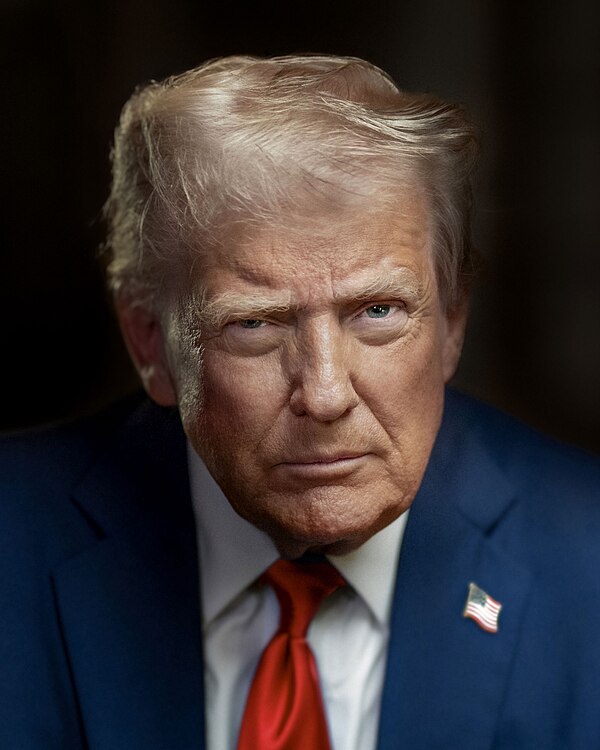
Official portrait of Donald J. Trump

Donald J. Trump

President of the United States

The 47th President of the United States, inaugurated January 20, 2025. As commander-in-chief, bears ultimate command responsibility for military operations and executive actions documented in this archive. Personally ordered or authorized the Iran war, Venezuela intervention, nuclear testing resumption, and mass deportation programs.

Linked Incidents

Grade 4 of 5: Critical Rights and Rule-of-Law Concern

Minab School Strike: US Tomahawk Cruise Missile Kills At Least 156 at a Primary School

A Tomahawk cruise missile struck a primary school in Minab, Iran, killing at least 156 people, including 120 to 123 children, in one of the deadliest single incidents of civilian harm in the 2026 Iran war. Media investigations, a preliminary US military inquiry as reported, and the UN fact-finding mission (A/HRC/63/61) attribute the strike to the US.

Grade 5 of 5: International Crime (Rome Statute)

Iran War: Crime of Aggression — War Launched Without Congressional Authorization

The United States launched a major war against Iran without congressional authorization, without a UN Security Council mandate, and while diplomatic channels remained open. The Brennan Center has called the strikes unconstitutional. International lawyers including Adil Haque and Brian Finucane (Just Security) and UN special procedures have characterized them as a manifest violation of the UN Charter and an act of aggression — what the Nuremberg Tribunal called 'the supreme international crime.'

Grade 4 of 5: Critical Rights and Rule-of-Law Concern

Trump Threats to Obliterate Iran's Civilian Power Infrastructure

Trump's explicit threats to destroy Iran's civilian power infrastructure escalated from 'obliterate' to a promise of 'complete demolition' of every bridge and power plant. Amnesty International characterised them as threats to commit war crimes; no tribunal or UN body has found a threat itself criminal, and a threat is not a listed Rome Statute act. Strikes that were later carried out on Iranian bridges and power infrastructure are assessed in their own entries.

Grade 4 of 5: Critical Rights and Rule-of-Law Concern

Attacks on Iranian Healthcare Facilities: WHO Verifies 18 Strikes on Hospitals and Medical Infrastructure

A sustained pattern of strikes on Iranian hospitals, ambulances, and medical infrastructure has killed healthcare workers and forced the evacuation of six hospitals. The WHO verified 18 attacks on health sites through mid-March 2026, documenting systematic damage to protected medical facilities including Gandhi Hospital and Iranian Red Crescent centers. WHO counted 21 attacks on health workers and facilities by late March, with 17 Red Crescent centres struck and nearly 100 ambulances damaged or destroyed.

Grade 3 of 5: Serious Rights Violation

Damage to Iranian UNESCO World Heritage Sites in US-Israeli Airstrikes

US-Israeli strikes have damaged UNESCO World Heritage Sites and over 100 cultural heritage sites across Iran, including Golestan Palace, Isfahan's Naqsh-e Jahan Square complex, the 8th-century Jameh Mosque, and prehistoric sites dating to 63,000 BC. Damage to cultural property is regulated by the 1954 Hague Convention and customary IHL. Intentionally directing attacks against historic monuments that are not military objectives is a war crime (Rome Statute art. 8(2)(b)(ix)); the documented damage so far was caused by strikes on nearby government buildings, and no investigative body has found that a heritage site was itself targeted.

Grade 5 of 5: International Crime (Rome Statute)

Operation Absolute Resolve: Unilateral US Military Intervention in Venezuela

The United States launched a unilateral military intervention in Venezuela, bombing infrastructure and capturing the sitting head of state, without Congressional authorization or UN Security Council mandate. The administration called it a law-enforcement operation, with military support, to arrest an indicted fugitive. International legal experts, the UN Secretary-General, and governments worldwide condemned the operation as a violation of the UN Charter.

Grade 4 of 5: Critical Rights and Rule-of-Law Concern

Naval Blockade of Venezuelan Oil Exports

A naval blockade of Venezuelan oil exports drew condemnation from UN experts as a violation of fundamental international law, with legal analysts characterizing it as an act of war imposed without Congressional authorization.

Grade 5 of 5: International Crime (Rome Statute)

Operation Southern Spear: Lethal Drone Strikes on Caribbean and Pacific Drug Boats

A sustained campaign of Hellfire missile strikes on suspected drug boats has killed at least 231 people (CBS News count, September 2026) without due process, public evidence of drug trafficking, or identification of the dead. The UN High Commissioner for Human Rights, UN Special Rapporteur Ben Saul and Human Rights Watch characterise the strikes as extrajudicial killings; Saul's September 2026 briefing note to the Human Rights Council found reasonable grounds that they constitute a crime against humanity, as have several scholars (Lawfare, War on the Rocks).

Grade 5 of 5: International Crime (Rome Statute)

Operation Rough Rider: US Killed More Civilians in 52 Days Than in Previous 23 Years in Yemen

A 53-day US bombing campaign in Yemen produced an unprecedented civilian death toll, with Airwars documenting at least 224 civilian deaths — nearly matching the 258 it recorded over the previous 23 years of US operations in Yemen. Two incidents, the Ras Isa port strike and the Saada migrant detention centre strike, reach the war-crime threshold at the probable level.

Grade 5 of 5: International Crime (Rome Statute)

US Strikes on Ras Issa Fuel Port Kill 84+ Civilians in Yemen

US airstrikes on Yemen's most critical civilian port infrastructure killed 84+ civilians including three children, port workers, truck drivers, and civil defense personnel. HRW found the strikes an apparent war crime: CENTCOM's stated aim of depriving the Houthis of fuel revenue does not make the port a military objective, and even if valid military objectives were attacked, the civilian harm most likely made the attack unlawfully disproportionate.

Grade 2 of 5: Major Abuse of Power

Systematic Pardons of Political Allies and Financial Criminals — $1.3 Billion in Victim Restitution Erased

A systematic pattern of pardons benefiting political allies, donors, and financial criminals. Over half of 88 clemency grants went to white-collar offenders, erasing $1.3 billion in victim restitution. Twenty corrupt politicians were pardoned. The DOJ's Public Integrity Section — responsible for investigating corruption — has been largely dismantled, and the head of the Pardon Attorney's office was fired and replaced with a political loyalist.

Grade 3 of 5: Serious Rights Violation

Expanded Travel Ban Targeting Up to 39 Countries, Predominantly Muslim and African Nations

A sweeping expansion of travel restrictions targeting predominantly Muslim-majority and African nations, growing from the original first-term ban to cover 39 countries. The bans affect millions of people and have been widely characterized as religious and racial discrimination codified into immigration policy.

Grade 2 of 5: Major Abuse of Power

Military and Economic Threats Against Greenland and Panama Canal Sovereignty

The administration threatened military and economic coercion to annex Greenland and reclaim the Panama Canal, with the Pentagon developing actual invasion plans. In a May 2025 NBC interview Trump refused to rule out military force to acquire Greenland; in January 2026 he threatened tariffs on European allies over it before ruling out force at Davos.

Grade 4 of 5: Critical Rights and Rule-of-Law Concern

Executive Order Sanctioning International Criminal Court Officials

The administration imposed escalating sanctions on ICC officials -- including judges and prosecutors -- for investigating US citizens and allies, obstructing international criminal accountability and drawing broad condemnation from the UN and international legal community.

Grade 4 of 5: Critical Rights and Rule-of-Law Concern

ICC Immunity Demands: Ultimatum to Amend Rome Statute and Exempt Americans from War Crimes Prosecution

A systematic campaign to destroy the International Criminal Court's ability to hold Americans accountable for war crimes, combining unprecedented sanctions on judges with demands to rewrite the Rome Statute itself. The campaign goes far beyond any previous US opposition to the ICC, seeking not merely non-cooperation but the permanent restructuring of international criminal justice.

Grade 2 of 5: Major Abuse of Power

Executive Orders Targeting Law Firms Representing Trump's Opponents

Unprecedented use of executive orders to punish four law firms for representing clients adverse to the president. All four orders were struck down as unconstitutional violations of the First, Fifth, and Sixth Amendments. The campaign chilled legal representation and coerced at least nine other firms into compliance deals that remain operative.

Grade 2 of 5: Major Abuse of Power

Weaponization of Security Clearances for Political Retaliation

A systematic campaign of security clearance revocations targeting political opponents, critics, and former officials who investigated or prosecuted Trump, including 51 intelligence officials, prosecutors, state attorneys general, and even an entire private cybersecurity company — constituting an unprecedented use of classification authority for political punishment.

Grade 3 of 5: Serious Rights Violation

Systematic Destruction of Environmental Protections — Paris Agreement, UNFCCC, and Endangerment Finding

An unprecedented withdrawal from the Paris Agreement, UNFCCC, and IPCC, combined with the rescission of the endangerment finding and rollback of 31+ environmental rules, constitutes the most comprehensive destruction of environmental protections in US history. The actions remove the world's largest historical emitter from the international climate framework while eliminating domestic regulation of greenhouse gases.

Grade 2 of 5: Major Abuse of Power

US Withdrawal from the World Health Organization With 2024–25 Dues Unpaid

The US left the WHO on January 22, 2026 without paying what it owed for 2024 and 2025, about $260–270 million according to the WHO and the UN. The 1948 joint resolution that authorized US membership makes the right to withdraw conditional on meeting US financial obligations for the WHO's current fiscal year. HHS says the US is under no obligation to pay.

Grade 2 of 5: Major Abuse of Power

America First Arms Transfer Strategy: Human Rights Safeguards Removed From Weapons Exports

An executive order removed human-rights weighting from US executive arms transfer policy, replacing decades of bipartisan policy with a commerce-first approach. The subsequent emergency bypass of congressional review for $23+ billion in Gulf arms sales demonstrated the immediate consequences of removing these guardrails.